Guide to Hair Wax: Science, Style, and Ingredients
Whether you’re aiming for a classic pompadour, a messy textured crop, or a sleek professional look, hair wax is the undisputed MVP of grooming. Unlike gels that leave your hair crunchy or sprays that feel stiff, hair wax offers a pliable, touchable hold that adapts to your day.
But what actually goes into that little puck of product? Let’s break down the chemistry behind the style.
The Core Anatomy: What’s Inside?
The performance of any hair wax—how it holds, how it shines, and how it washes out—depends on its four primary ingredient pillars.
The Structural Base
This is the “skeleton” of the product. It provides the stiffness and vertical support needed to defy gravity.
Beeswax: The gold standard. It provides a reliable hold with a natural, healthy sheen while acting as a natural moisturizer.
Carnauba Wax: Derived from palm trees, this is the “heavy lifter.” It’s much harder than beeswax and is used in high-hold products for thick, stubborn hair.
Microcrystalline Wax: A petroleum-derived synthetic that provides the “memory” in the wax. It’s what allows you to restyle your hair throughout the day without adding more product.
Emollients & Oils
These ingredients determine how easily the wax spreads between your palms and how much shine it reflects.
Petrolatum (Vaseline): The engine of classic oil-based waxes. It creates that iconic high-shine “slick” look but requires a deep-cleansing shampoo to remove.
Plant-Based Oils (Jojoba, Castor, Argan): These serve a dual purpose: they make the wax creamy and easy to apply while nourishing the hair shaft and scalp.
Glycerin: A humectant found in water-based waxes that helps retain moisture so your hair doesn’t look brittle by 5 PM.
Texturizers & Matting Agents
Modern styles often favor a “no-product” look. This is achieved by adding minerals that soak up light and oil.
Kaolin & Bentonite Clay: These volcanic clays absorb excess sebum (scalp oil), providing a dry, matte finish and massive volume for “messy” styles.
Diatomaceous Earth: A powerful absorbent used in “extreme matte” products to ensure zero shine and maximum friction.
Performance Additives
Emulsifiers (PEGs): These are the “peacekeepers” that allow oil and water to mix, ensuring the product stays stable in the jar and rinses off easily in the shower.
Fragrance: From sophisticated oud and cedarwood to fresh citrus, this defines the sensory experience.
Why Choose Wax? Key Characteristics
What separates hair wax from its cousins like gel, mousse, or hairspray?
Reworkability: Wax never “sets” into a hard shell. If you wear a helmet or get caught in the wind, you can simply run your hands through your hair to reshape it.
Versatile Shine Spectrum: Whether you want a “high-gloss wet look” or a “bone-dry matte finish,” there is a wax formulation designed for that specific light reflection.
Natural Movement
It clumps hair fibers together for definition but allows the hair to retain its natural flexibility.
Universal Utility: It’s effective across all hair lengths, though it truly shines on short to medium-length hair for creating texture and separation.
Quick Reference: Finding Your Match
| Product Type | Key Ingredients | The Vibe | Washability | Best For |
| Water-Based Wax | Water, Micro-waxes | Natural shine, easy glide | ⭐ (Easy) | Daily office looks |
| Matte Clay | Kaolin, Bentonite | Zero shine, high volume | ⭐⭐⭐ (Moderate) | Fine/Oily hair, “messy” crops |
| Oil-Based Pomade | Petrolatum, Beeswax | High shine, vintage slick | ⭐⭐⭐⭐⭐ (Difficult) |
Hair wax production process
Phase Preparation
Hair wax production begins by separating ingredients into two distinct tanks: the Oil Phase and the Water Phase.
The Oil Phase: In a large heated stainless steel vat, solid waxes (Beeswax, Carnauba, or Microcrystalline) are combined with oils (Castor oil, Lanolin, or Petrolatum). These are heated to approximately 75°C to 85°C until they reach a uniform liquid state.
The Water Phase: In a separate tank, distilled water is mixed with water-soluble components like Glycerin (for moisture) and PVP/VA copolymers (for “film-forming” hold). This mixture is also heated to match the temperature of the oil phase to prevent “thermal shock” during mixing.
Emulsification
This is the most critical stage. Under high-shear agitation, the water phase is slowly introduced into the oil phase.
Because oil and water naturally repel each other, an emulsifier (such as Ceteareth-25 or Glyceryl Stearate) acts as a molecular bridge. A high-speed homogenizer rotates at thousands of RPMs to break the oil into microscopic droplets, dispersing them evenly throughout the water. This creates the creamy, smooth texture of the wax.
Incorporation of Solids
For matte waxes or “clays,” this is when the texturizing agents are introduced.
Clay Dispersion: Fine powders like Kaolin or Bentonite are sifted into the emulsion.
Cooling Control: The temperature is slowly lowered. If it cools too fast, the wax becomes brittle; too slow, and it remains a soup. Manufacturers use “jacketed” cooling tanks that circulate cold water around the exterior of the vat to manage this transition.
Cooling and Fragrance
Fragrance oils and essential oils are highly volatile and can evaporate or “flash off” if added to boiling liquids. Therefore, the batch is cooled to roughly 45°C to 50°C before the scent and preservatives (to prevent mold and bacteria growth) are folded in
Automated Filling and Setting
The wax is still in a pourable, semi-liquid state at this stage.
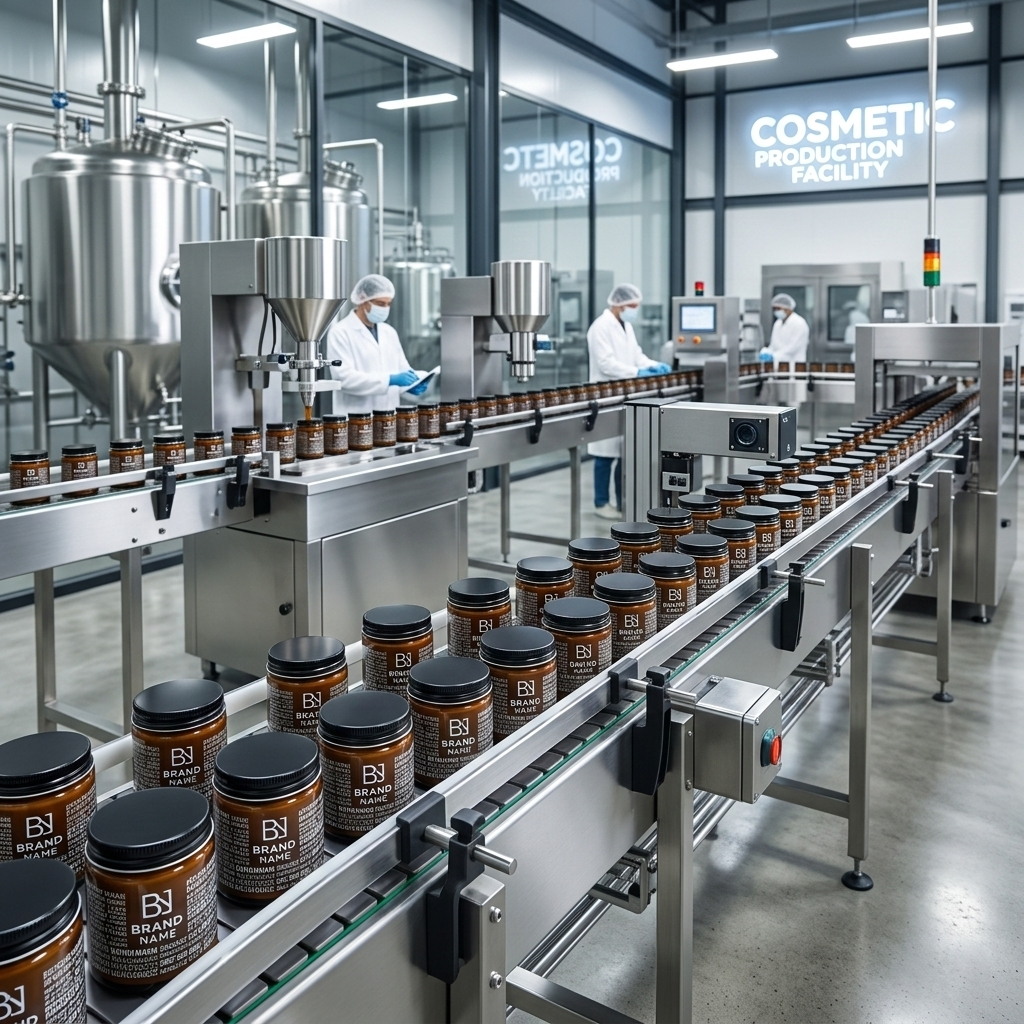
Conveyor Injection: Automated nozzles dispense a precise weight of liquid wax into plastic or aluminum tins.
Cooling Tunnel: The open tins pass through a cooling tunnel (essentially a long industrial refrigerator). This allows the waxes to “set” and crystallize, giving the product its final firm surface.
Capping & Labeling: Once solid, the tins are capped, induction-sealed for freshness, and labeled with batch numbers for quality tracking.
Summary of the Process Flow
| Stage | Action | Purpose |
| Melting | Heating waxes/oils to 80°C | Liquefying solids for blending |
| Homogenization | High-shear mixing | Creating a stable emulsion |
| Sifting | Adding Clays/Powders | Creating matte texture and “grip” |
| Stabilizing | Adding Preservatives | Ensuring 12–24 month shelf life |
| Setting | Flash-cooling in tins | Achieving the final “scoopable” density |
F.A.Q.
Get instant answers to your questions in our FAQ section.
Our MOQ starts at just 500 pieces, making it accessible for boutique salons and growing chains alike.
Absolutely! We specialize in high-quality logo integration to ensure your existing brand looks stunning on our jars.
Typically, from design approval to delivery, the turnaround time is between 4–6 weeks, depending on your location.
We offer a range of professional formulas, including Matte Clay, High-Shine Pomade, and Medium-Hold Fiber.
Basic placement and adjustment of your logo are included in our service package.
Yes. Our formulas are developed for professional use, ensuring they wash out easily and provide long-lasting hold without flakes.
We work closely with you during the design phase to ensure the digital mockup meets your expectations before mass production begins.
We specialize in the American market but have the logistics capacity to ship to various regions. Contact us for specific shipping quotes.
For our 500-piece tier, we use our signature professional scents. Custom scent profiles are available for higher-volume orders.
Simply click the “Request a Quote” button, and a brand consultant will reach out to walk you through the options.
Let’s Build Your Brand
Whatsapp and phone number: +852-6585-0344
Or contact us via Whatsapp on the bottom left
Email: koohancom@gmail.com